
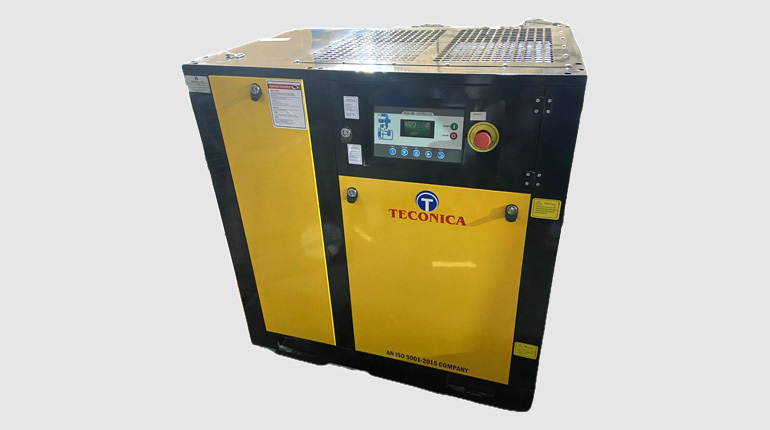
A Single Stage Screw Air Compressor is a type of rotary screw compressor that operates using a single stage of compression to deliver compressed air. These compressors are widely used in industries due to their efficiency, durability, and ability to provide continuous compressed air output. Here's a detailed description:
| MODEL TECONICA |
MOTOR | WORKING PRESSURE |
FREE AIR DELIVERY |
TRANSMISSION TYPE (RPM - 2900) |
SOUND LEVEL |
DIMENSIONS (LWH) |
WEIGHT | |
| kW | HP | BAR g. | CFM | DB | MM | KG | ||
| TCS-5D | 3.25 | 5 | 8 / 10 | 22 / 20.4 | Direct Driven | 65 | - | - |
| TCS-7.5D | 5.5 | 7.5 | 8 / 10 / 13 | 33 / 28 / 22 | Direct Driven | 65 | ||
| TCS-10D | 7.5 | 10 | 8 / 10 / 13 | 47 / 40 / 33 | Direct Driven | 65 | ||
| TCS-15D | 11 | 15 | 8 / 10 / 13 | 60 / 49.8 / 46.3 | Direct Driven | 68 | ||
| TCS-20D | 15 | 20 | 8 / 10 / 13 | 88.2 / 78 / 55.9 | Direct Driven | 68 | ||
| TCS-25D | 18.5 | 25 | 8 / 10 / 13 | 110 / 93 / 74.3 | Direct Driven | 68 | ||
| TCS-30D | 22 | 30 | 8 / 10 / 13 | 127.3 / 112.9 / 99 | Direct Driven | 68 | ||
| TCS-40D | 30 | 40 | 8 / 10 / 13 | 176.7 / 159 / 135 | Direct Driven | 68 | ||
| TCS-50D | 37 | 50 | 8 / 10 / 13 | 220 / 200 / 175 | Direct Driven | 68 | ||
| TCS-60D | 45 | 60 | 8 / 10 / 13 | 272 / 246 / 204 | Direct Driven | 68 | ||
| TCS-75D | 55 | 75 | 8 / 10 / 13 | 357 / 318 / 300 | Direct Driven | 68 | ||
| TCS-100D | 75 | 100 | 8 / 10 / 13 | 470 / 410 / 354 | Direct Driven | 68 | ||
| TCS-120D | 90 | 120 | 8 / 10 / 13 | 548 / 515.5 / 435 | Direct Driven | 68 | ||
| TCS-150D | 110 | 150 | 8 / 10 / 13 | 725 / 620 / 575 | Direct Driven | 68 | ||
| TCS-175D | 132 | 175 | 8 / 10 / 13 | 885 / 777 / 725 | Direct Driven | 68 | ||
| TCS-200D | 160 | 200 | 8 / 10 / 13 | 975 / 868 / 760 | Direct Driven | 68 | ||
Rotors: The core of a screw air compressor consists of two helical rotors, commonly called the male and female rotors. These rotors mesh together to compress the air as it passes between them.
Inlet Valve: This valve allows atmospheric air to enter the compression chamber.
Compression Chamber: As the rotors turn, the air trapped between them gets compressed. The design ensures that the volume of air decreases as it moves through the chamber, raising the pressure.
Oil Circuit (in oil-injected models): In oil-injected models, oil is introduced into the compression chamber to lubricate the rotors, cool the air, and seal gaps between the rotors for efficient compression. The oil is later separated from the compressed air.
Cooling System: Heat is generated during the compression process, so a cooling system (air or water-cooled) is essential to maintain operational efficiency.
Air-Oil Separator (for oil-injected types): After compression, the oil must be removed from the air before it is sent to the output line. This component ensures that only clean compressed air is delivered to the application.
Discharge Port: Once compressed, the air exits the compressor through this port to be used in industrial processes.
Air Inlet: Air enters through the inlet valve and flows into the space between the two rotors.
Compression: As the rotors rotate, they trap the air and reduce the volume between them, compressing the air. In a single-stage system, this compression occurs in one continuous process until the desired pressure is reached.
Air Discharge: Once compressed, the air is discharged through the outlet port. In oil-injected systems, the compressed air passes through an air-oil separator to remove any oil particles before being delivered for use.
Single Compression Stage: In a single-stage compressor, the air is compressed in one step, which makes it suitable for applications that require lower pressures (up to around 100-125 psi).
Efficiency: The rotary screw design allows for smooth, continuous air compression, offering better efficiency than piston compressors for many industrial applications.
Durability: Screw compressors have fewer moving parts compared to other types of compressors, resulting in less wear and tear and a longer service life.
Low Vibration and Noise: The rotary motion of the screw mechanism minimizes vibrations, leading to quieter operation compared to other compressor types.
Industrial plants for powering machinery
Automotive assembly lines
Food processing
Chemical manufacturing
Construction sites (for pneumatic tools)